CASE STUDY 01 · ASPEN GROUP
Scaling Editorial Operations
Aspen University | United States University | 2021–2023
Scaling content requires more than increasing production. It demands a strategic infrastructure capable of aligning business objectives, audience intelligence, creative resources, and editorial execution – without compromising quality or operational efficiency.
At Aspen Group, I played a central role in transforming the content production process across two higher education brands. My work focused on developing a more efficient, scalable editorial operation by restructuring production workflows, managing a network of freelance contributors, and strengthening the processes that governed content planning, development, quality assurance, and publication.
I helped establish a more systematic, data-informed approach to editorial planning, leveraging SEO research, competitive analysis, audience insights, and content performance metrics to identify opportunities and inform publishing priorities. This included developing comprehensive content briefs, coordinating assignments and deadlines, refining editorial standards, and overseeing content through successive stages of review and optimization.
Beyond improving production capacity, my efforts focused on creating greater consistency and accountability throughout the editorial lifecycle. By connecting strategic planning with day-to-day execution, I helped build a more coordinated content operation capable of responding to evolving business priorities, expanding organic visibility, and maximizing the effectiveness of available resources.
The result was a more structured, performance-oriented editorial operation – one designed not simply to produce more content, but to produce the right content, more efficiently and at scale.
The Challenge
Increasing editorial capacity without sacrificing quality, consistency, or strategic focus.
Supporting two higher education brands required a coordinated approach to content production, with competing editorial priorities, limited resources, and an ongoing need for relevant, search-optimized content.
The challenge extended beyond increasing publishing volume. Each stage of the editorial lifecycle – from identifying content opportunities and developing assignments to coordinating freelance contributors, reviewing deliverables, and managing publication – needed to function as part of a cohesive operation.
The objective was to establish a more efficient and repeatable production model that could accommodate evolving content demands, improve resource utilization, and maintain editorial standards across both institutions.
Ultimately, the challenge was as much operational as it was creative: how do you increase production capacity while ensuring that every piece of content remains purposeful, relevant, and aligned with broader marketing objectives?
The Strategy
Building an editorial engine – not simply increasing output.
The solution wasn't to produce more content for the sake of producing more. It was to rethink how content moved from opportunity to execution – and build a more intelligent, coordinated, and scalable operation around it.
My approach centered on a straightforward principle: Better systems empower better people to produce better work.
I helped reengineer the editorial process around three interconnected priorities: strategic intelligence, operational efficiency, and editorial excellence. Each served a distinct purpose, but together they created a more cohesive framework for turning audience insights into meaningful content at scale.
01. Make Intelligence the Foundation of Every Editorial Decision
Effective content strategy begins long before the first word is written.
I integrated keyword research, competitive analysis, audience behavior, and performance insights into the editorial planning process, using data to identify opportunities, evaluate search demand, and inform publishing priorities.
Rather than relying on disconnected assignments, I developed approximately 25 comprehensive SEO content briefs per month, translating research into actionable editorial direction for freelance contributors and subject matter experts.
These briefs served as more than writing assignments. They connected search intent, audience needs, content structure, and brand expectations – helping ensure that every article began with a defined purpose and a clear path to execution.
02. Engineer a Smarter, More Scalable Production Model
A successful editorial operation depends on more than talented writers. It requires an infrastructure that allows their talent to flourish.
I helped restructure the production lifecycle, coordinating a network of freelance contributors and refining the processes governing assignments, communication, deadlines, editorial reviews, and publication. And of course, repurposing content to the MAX.
The objective was to introduce greater clarity and consistency into an increasingly complex operation. By establishing repeatable workflows and strengthening coordination between contributors and editorial priorities, we developed a production model better equipped to accommodate growing content demands without compromising standards.
The fundamental shift was from managing individual deliverables to strengthening the system responsible for delivering them.
03. Build Quality, Accountability, and Optimization Into the Process
Greater production capacity means little if it comes at the expense of relevance, credibility, or performance.
I worked to strengthen editorial quality assurance through consistent review practices, clearer brand guidelines, SEO standards, and more deliberate content optimization.
This meant treating publication not as the conclusion of the editorial process, but as part of an ongoing cycle of evaluation and improvement.
Content audits, audience insights, and performance analysis helped inform subsequent editorial decisions, identify opportunities to refresh existing material, and maintain alignment between what we produced and what audiences actually needed.
The aim was to create an operation capable not only of publishing efficiently, but of learning, adapting, and improving over time.
The Philosophy Behind the Strategy
Scale the intelligence. Strengthen the process. Empower the people.
What emerged was a more deliberate approach to content operations – one that connected research with creative execution, individual contributors with shared objectives, and editorial output with broader business priorities.
The experience reinforced something I consider fundamental to content leadership: meaningful growth doesn't come from asking people to do more with less indefinitely. It comes from building the clarity, structure, and collaborative environment that allow them to accomplish more together.
The goal was never simply to publish more content. It was to build a better way to produce it.
Results & Business Impact
A more scalable operation. Greater editorial capacity. A stronger foundation for growth.
The changes to editorial planning, contributor coordination, and production workflows helped establish a more systematic approach to content development across Aspen University and United States University.
By connecting research-driven planning with a coordinated freelance network and consistent editorial oversight, the initiative demonstrated how operational improvements could expand production capacity while supporting the quality and strategic direction of published content.
Production Growth & Operational Impact
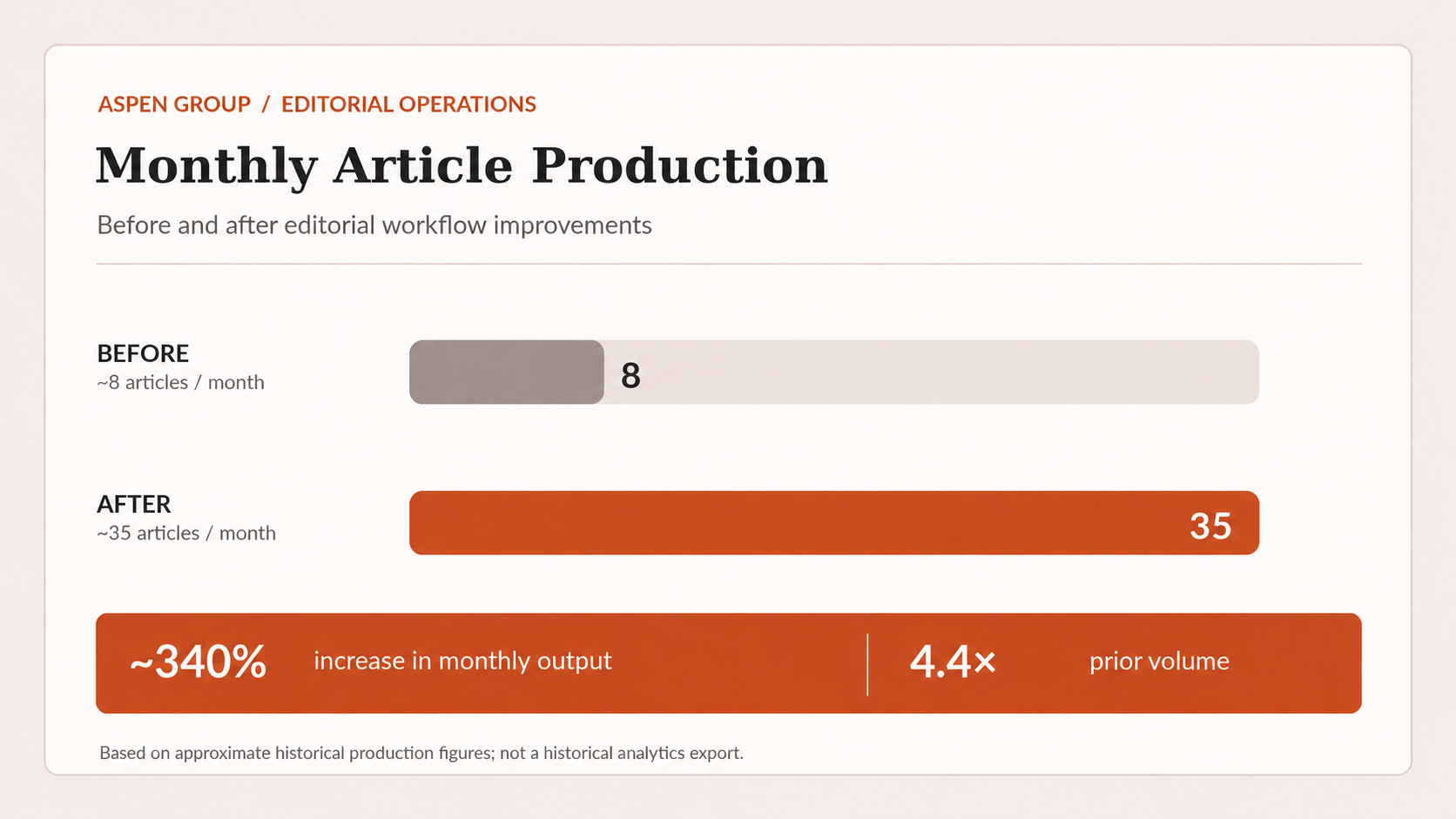
~340% Increase in Monthly Article Production
Helped transform editorial production capacity from approximately 8 to 35 articles per month by restructuring publishing workflows, coordinating freelance contributors, and establishing a more systematic approach to content planning, development, and quality assurance.
25 SEO Content Briefs Developed Monthly
Developed approximately 25 research-driven SEO briefs each month, translating audience insights, keyword intelligence, and competitive analysis into actionable editorial assignments. These briefs provided freelance contributors and subject matter experts with clear strategic direction, helping maintain a consistent publishing pipeline and authority across two higher education brands.
The result: A publishing operation capable of delivering more than four times its previous monthly output through improved processes and more effective use of available resources.
Scaling Editorial Production
Beyond the Numbers
The most meaningful outcome was the development of a more organized, repeatable editorial process – one that better connected content planning, production resources, and execution.
This experience reinforced a principle that continues to shape my approach to content leadership:
Sustainable growth isn't simply a matter of producing more. It's about building the people, processes, and strategic foundations that make better performance possible.