Content Strategy. Creative Direction. Measurable Impact.
I connect audience intelligence, compelling storytelling, and scalable content operations to drive meaningful business growth.
About Me

A storyteller's instinct. A strategist by design. Ambitious leader hungry for results.
I've always been fascinated by the power of a good story. What makes people pay attention? What makes an idea resonate? And perhaps most importantly, what makes it matter?
With more than a decade of experience across media, digital marketing, and filmmaking, I've learned that compelling content is only part of the equation. The greater challenge – and the one I find most rewarding – is developing the strategy, aligning the people, and building the processes that turn creative potential into meaningful results.
My work has taken me well beyond the written word. I've helped shape editorial strategies, direct multimedia projects, guide creative contributors, streamline content operations, and translate complex ideas into narratives that connect with audiences and advance business objectives. Along the way, I've learned to think beyond individual deliverables and consider the larger picture: how content supports an organization, strengthens its identity, and contributes to its long-term growth.
That perspective is informed by an unconventional combination of disciplines. My background in film production taught me to think visually, embrace complexity, and appreciate the power of human connection. My experience in digital marketing sharpened my understanding of audience behavior, performance, and the relationship between creativity and commercial success. And through my MBA studies at Boston University's Questrom School of Business, I'm expanding that foundation with a deeper understanding of organizational leadership, business strategy, and decision-making. I am also SEO Certified by Semrush Academy.
But credentials and experience only tell part of the story.
I'm endlessly curious about people, ideas, and the world around me. I enjoy challenging assumptions, connecting seemingly unrelated concepts, and asking questions that lead somewhere unexpected. I value thoughtful collaboration, intellectual honesty, and the kind of creative environment where ambitious ideas are encouraged – and challenged to become better.
Ultimately, I want to do more than create work that earns attention. I want to help build the vision, culture, and capabilities that make exceptional work possible.
Because the real measure of great content isn't simply what it says. It's what it makes possible.
Selected Career Impact
~340%
Increase in Article Production
30+
First-Page Google Rankings
40+
Videos Written, Directed, & Produced
123%
Blog Audience Growth
17.3M
Reported Social Sessions Across 24 Months
I have contributed towards many national brands in a variety of industries

Professional Experience

Content Director
Content Strategy | Editorial Leadership | Brand Development
Rasmussen | American Public University | American Military University
April 2023 - Current
Shape and advance multibrand content strategies that connect institutional priorities, audience intelligence, and creative execution to measurable marketing objectives. Working in close partnership with senior content leadership, translate business goals into long-term editorial roadmaps, integrated campaigns, and scalable content initiatives designed to strengthen brand authority, accelerate organic growth, and improve the prospective student experience.
Provide strategic and editorial direction across a diverse content portfolio spanning academic program marketing, search optimization, thought leadership, digital campaigns, and multimedia storytelling. Collaborate with marketing teams, academic stakeholders, subject-matter experts, and creative contributors to align messaging, establish editorial priorities, and deliver cohesive brand experiences across channels.
Apply audience research, competitive analysis, Google Analytics, and search performance insights to guide content decisions, uncover growth opportunities, and continuously improve content effectiveness. Balance creative ambition with commercial objectives, ensuring content serves a defined purpose within the broader customer journey.
Help evolve content operations by refining editorial workflows, strengthening production processes, and introducing integrated storytelling approaches that connect written, visual, and video content. Foster collaboration across disciplines while advancing the consistency, quality, and strategic value of the organization's content ecosystem.
Strategic Expertise: Content Strategy & Governance | Editorial Direction | Brand Positioning | Organic Growth & SEO | Content Operations | Audience Intelligence | Integrated Campaigns | Performance Measurement | Cross-Functional Leadership

Senior Copywriter
Content Strategy | Editorial Leadership
Aspen University | United States University
2021-2023
Helped transform content strategy and editorial operations across two higher education brands, connecting audience intelligence, organic growth initiatives, and scalable production systems to broader marketing objectives. Combined strategic planning with hands-on editorial leadership to expand content output, strengthen search visibility, and deliver measurable audience growth within a resource-constrained environment.
Played a central role in building a more efficient, performance-driven content operation – restructuring editorial workflows, coordinating a network of freelance writers, and establishing clearer processes for content development, quality assurance, and publication. Used SEO intelligence, competitive research, and audience analytics to inform editorial priorities and guide content investments toward opportunities with the greatest potential impact.
Worked across content strategy, brand messaging, organic search, social media, and digital marketing to connect individual creative initiatives to larger organizational goals. Helped establish editorial guidelines, maintain brand consistency, and develop integrated content that supported audience acquisition, engagement, and prospective student journeys.
Selected Achievements & Impact
~ 340% increase in article production: Redesigned editorial workflows and leveraged a network of freelance writers to expand publishing capacity while maintaining editorial oversight and quality standards.
123% growth in blog audience: Helped grow readership from 26,000 to 58,000 in just six months, using targeted SEO initiatives and content optimization despite limited resources.
23% increase in website sessions: Applied audience analytics, keyword research, competitive intelligence, and content audits to identify optimization opportunities and strengthen website performance.
30+ first-page Google rankings: Developed and optimized search-focused content that improved organic discoverability and competitive search visibility.
25 SEO content briefs per month: Directed freelance assignments through research-driven briefs, editorial guidance, content reviews, and publishing coordination.
306% increase in social sessions: Contributed to social content initiatives associated with growth from 320,000 to 1.3 million sessions across comparable nine-month periods.
Strategic Capabilities: Content Strategy & Operations | Editorial Leadership | SEO & Organic Growth | Audience Acquisition | Performance Analytics | Freelance Contributor Management | Brand Governance | Content Optimization | Multichannel Marketing

Copywriter, Video Producer
SlumberYard.com | ThePointsGuy.com | Reviews.com | TheSimpleDollar.com | Safety.com GradSchoolHub.com | TheBestSchools.org
2016-2021
Built a multidisciplinary foundation in digital publishing, combining content strategy, search optimization, and multimedia storytelling across seven established digital brands. Collaborated with SEO, business development, and creative teams to transform audience intelligence into compelling content, scalable production workflows, and revenue-focused marketing initiatives.
At Reviews.com, a Red Ventures-owned property, I contributed to SEO and editorial initiatives supporting the brand's commercial growth strategy. During my tenure, Reviews.com achieved its first $1 million month in affiliate revenue – a significant milestone demonstrating the commercial potential of a coordinated, audience-focused content operation.
Selected Achievements & Impact
Developed 1,000+ original content assets spanning SEO-driven editorial, digital advertising, landing pages, email campaigns, and social media across multiple brands.
Wrote, directed, and produced 40+ videos for YouTube and digital marketing channels, overseeing creative development from concept through production and distribution.
Established scalable multimedia workflows supporting the consistent production of 1–4 original content assets weekly across multiple platforms.
Advanced editorial strategy and operational efficiency through data-informed content planning, cross-platform repurposing, and the development of publishing standards and brand guidelines.
Strategic Leadership Work Sample
A 90-Day Test of Content Leadership
An original strategic demonstration | Content Strategy • Resource Allocation • Performance Accountability
A full editorial calendar can still be a failed strategy.
When resources are limited, priorities compete, and leadership expects measurable growth, the challenge isn't simply determining what an organization can publish.
It's deciding what deserves investment—and what doesn't.
To demonstrate how I would approach that responsibility, I developed a 90-day content leadership strategy for a hypothetical career-focused education provider, working within an illustrative $54,000 discretionary budget.
The assignment: strengthen qualified audience acquisition, improve editorial efficiency, establish performance accountability, and build a foundation for sustainable growth.
But rather than stop at a strategic roadmap, I built the operating model behind the decisions.
The Decisions
Fund the opportunity. Challenge the assumption. Protect the investment.
Using a weighted prioritization framework, I evaluated competing content initiatives against their business relevance, organic growth potential, expert differentiation, feasibility, and operational value.
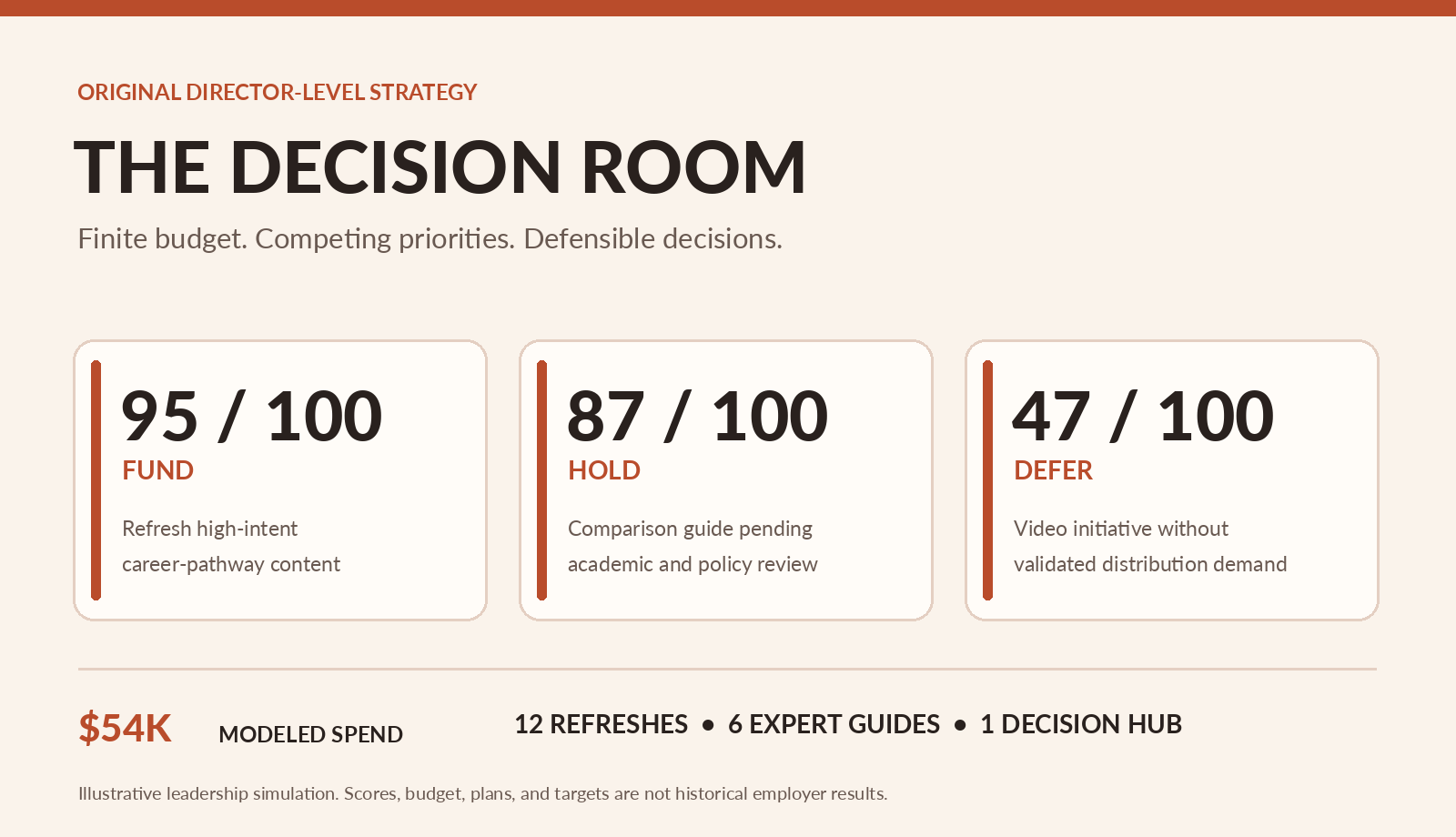
A high-intent content refresh scored 95/100, making it an immediate funding candidate.
A promising comparison guide scored 87/100—but remained on hold pending academic and policy verification.
A proposed video initiative scored 47/100 and was deferred without sufficient evidence of audience demand or distribution potential.
The distinction matters: Good strategy isn't about saying yes to the most promising ideas. It's about knowing when, why, and under what conditions an idea deserves a yes.
The Operating Plan
The accompanying executive blueprint and financial model translate these decisions into a coordinated 90-day strategy.
They include an editorial roadmap, unit-cost budget, resource allocation, expert-review standards, performance dashboard, sample content brief, and clearly defined decision rights.
Proposed deliverables include 12 priority content refreshes, six expert-led guides, and one improved decision-stage content experience—with funding released against evidence and operational readiness.
The Leadership Standard
Traffic is not the same as value. Output is not the same as progress.
My measurement approach connects search visibility and audience engagement with qualified inquiries, editorial quality, production efficiency, and responsible spending.
Equally important, the strategy establishes conditions for changing course when results disappoint, data proves unreliable, or quality begins to suffer.
Because the responsibility of a content leader isn't to defend every decision they've made.
It's to make the best decision possible with the evidence available—and have the judgment to make a different one when the evidence changes.
Explore the complete executive strategy and editable operating model below.
View Executive Strategy
Explore the Decision Model
This is an original hypothetical leadership exercise. All financial assumptions, priority scores, operating targets, and modeled outcomes are illustrative – not historical employer results.
Selected Case Studies
CASE STUDY 01 · ASPEN GROUP
Scaling Editorial Operations
Aspen University | United States University | 2021–2023
Scaling content requires more than increasing production. It demands a strategic infrastructure capable of aligning business objectives, audience intelligence, creative resources, and editorial execution – without compromising quality or operational efficiency.
At Aspen Group, I played a central role in transforming the content production process across two higher education brands. My work focused on developing a more efficient, scalable editorial operation by restructuring production workflows, managing a network of freelance contributors, and strengthening the processes that governed content planning, development, quality assurance, and publication.
I helped establish a more systematic, data-informed approach to editorial planning, leveraging SEO research, competitive analysis, audience insights, and content performance metrics to identify opportunities and inform publishing priorities. This included developing comprehensive content briefs, coordinating assignments and deadlines, refining editorial standards, and overseeing content through successive stages of review and optimization.
Beyond improving production capacity, my efforts focused on creating greater consistency and accountability throughout the editorial lifecycle. By connecting strategic planning with day-to-day execution, I helped build a more coordinated content operation capable of responding to evolving business priorities, expanding organic visibility, and maximizing the effectiveness of available resources.
The result was a more structured, performance-oriented editorial operation – one designed not simply to produce more content, but to produce the right content, more efficiently and at scale.
The Challenge
Increasing editorial capacity without sacrificing quality, consistency, or strategic focus.
Supporting two higher education brands required a coordinated approach to content production, with competing editorial priorities, limited resources, and an ongoing need for relevant, search-optimized content.
The challenge extended beyond increasing publishing volume. Each stage of the editorial lifecycle – from identifying content opportunities and developing assignments to coordinating freelance contributors, reviewing deliverables, and managing publication – needed to function as part of a cohesive operation.
The objective was to establish a more efficient and repeatable production model that could accommodate evolving content demands, improve resource utilization, and maintain editorial standards across both institutions.
Ultimately, the challenge was as much operational as it was creative: how do you increase production capacity while ensuring that every piece of content remains purposeful, relevant, and aligned with broader marketing objectives?
The Strategy
Building an editorial engine – not simply increasing output.
The solution wasn't to produce more content for the sake of producing more. It was to rethink how content moved from opportunity to execution – and build a more intelligent, coordinated, and scalable operation around it.
My approach centered on a straightforward principle: Better systems empower better people to produce better work.
I helped reengineer the editorial process around three interconnected priorities: strategic intelligence, operational efficiency, and editorial excellence. Each served a distinct purpose, but together they created a more cohesive framework for turning audience insights into meaningful content at scale.
01. Make Intelligence the Foundation of Every Editorial Decision
Effective content strategy begins long before the first word is written.
I integrated keyword research, competitive analysis, audience behavior, and performance insights into the editorial planning process, using data to identify opportunities, evaluate search demand, and inform publishing priorities.
Rather than relying on disconnected assignments, I developed approximately 25 comprehensive SEO content briefs per month, translating research into actionable editorial direction for freelance contributors and subject matter experts.
These briefs served as more than writing assignments. They connected search intent, audience needs, content structure, and brand expectations – helping ensure that every article began with a defined purpose and a clear path to execution.
02. Engineer a Smarter, More Scalable Production Model
A successful editorial operation depends on more than talented writers. It requires an infrastructure that allows their talent to flourish.
I helped restructure the production lifecycle, coordinating a network of freelance contributors and refining the processes governing assignments, communication, deadlines, editorial reviews, and publication. And of course, repurposing content to the MAX.
The objective was to introduce greater clarity and consistency into an increasingly complex operation. By establishing repeatable workflows and strengthening coordination between contributors and editorial priorities, we developed a production model better equipped to accommodate growing content demands without compromising standards.
The fundamental shift was from managing individual deliverables to strengthening the system responsible for delivering them.
03. Build Quality, Accountability, and Optimization Into the Process
Greater production capacity means little if it comes at the expense of relevance, credibility, or performance.
I worked to strengthen editorial quality assurance through consistent review practices, clearer brand guidelines, SEO standards, and more deliberate content optimization.
This meant treating publication not as the conclusion of the editorial process, but as part of an ongoing cycle of evaluation and improvement.
Content audits, audience insights, and performance analysis helped inform subsequent editorial decisions, identify opportunities to refresh existing material, and maintain alignment between what we produced and what audiences actually needed.
The aim was to create an operation capable not only of publishing efficiently, but of learning, adapting, and improving over time.
The Philosophy Behind the Strategy
Scale the intelligence. Strengthen the process. Empower the people.
What emerged was a more deliberate approach to content operations – one that connected research with creative execution, individual contributors with shared objectives, and editorial output with broader business priorities.
The experience reinforced something I consider fundamental to content leadership: meaningful growth doesn't come from asking people to do more with less indefinitely. It comes from building the clarity, structure, and collaborative environment that allow them to accomplish more together.
The goal was never simply to publish more content. It was to build a better way to produce it.
Results & Business Impact
A more scalable operation. Greater editorial capacity. A stronger foundation for growth.
The changes to editorial planning, contributor coordination, and production workflows helped establish a more systematic approach to content development across Aspen University and United States University.
By connecting research-driven planning with a coordinated freelance network and consistent editorial oversight, the initiative demonstrated how operational improvements could expand production capacity while supporting the quality and strategic direction of published content.
Production Growth & Operational Impact
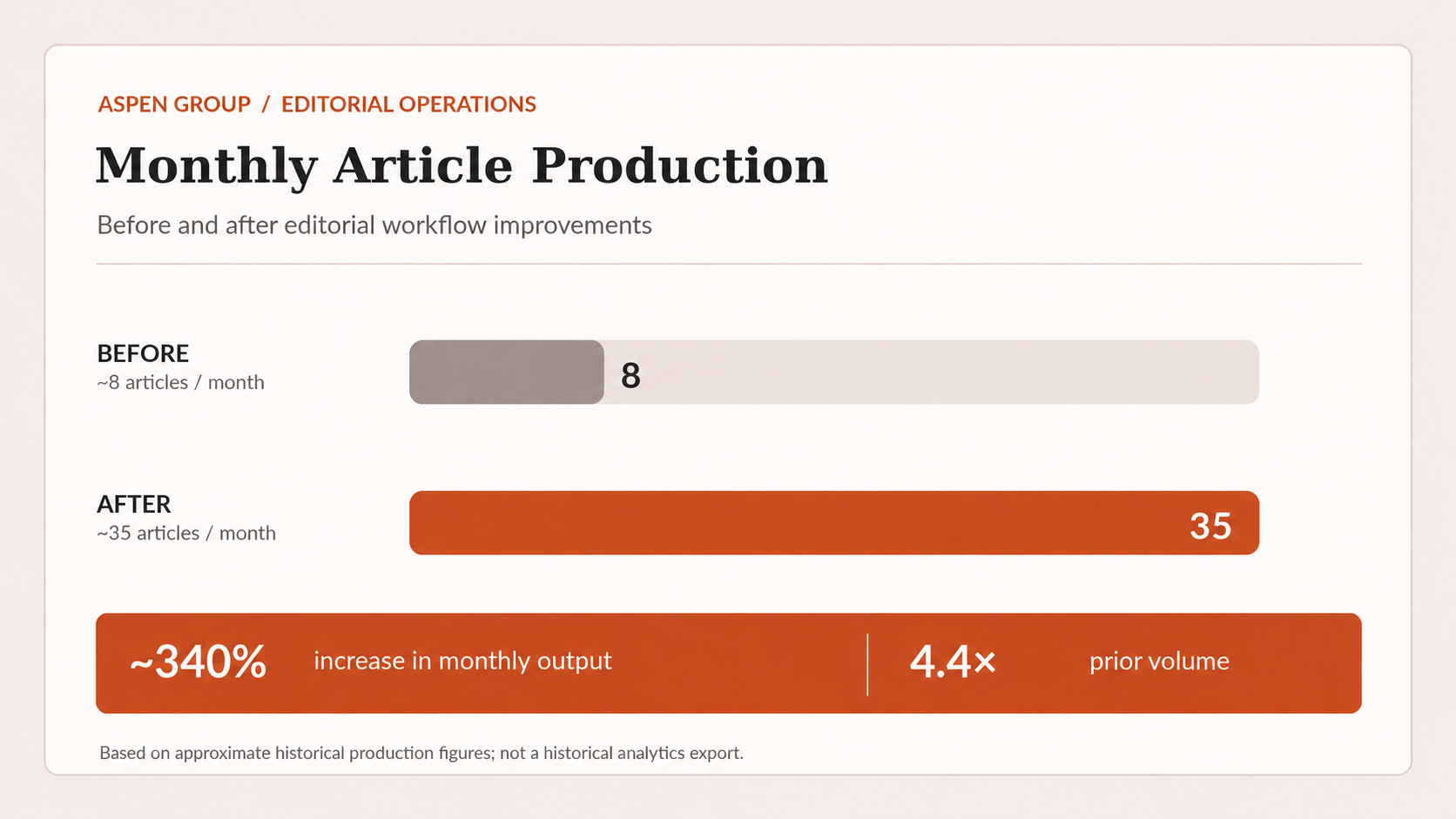
~340% Increase in Monthly Article Production
Helped transform editorial production capacity from approximately 8 to 35 articles per month by restructuring publishing workflows, coordinating freelance contributors, and establishing a more systematic approach to content planning, development, and quality assurance.
25 SEO Content Briefs Developed Monthly
Developed approximately 25 research-driven SEO briefs each month, translating audience insights, keyword intelligence, and competitive analysis into actionable editorial assignments. These briefs provided freelance contributors and subject matter experts with clear strategic direction, helping maintain a consistent publishing pipeline and authority across two higher education brands.
The Result: A publishing operation capable of delivering more than four times its previous monthly output through improved processes and more effective use of available resources.
Scaling Editorial Production
Beyond the Numbers
The most meaningful outcome was the development of a more organized, repeatable editorial process – one that better connected content planning, production resources, and execution.
This experience reinforced a principle that continues to shape my approach to content leadership:
Sustainable growth isn't simply a matter of producing more. It's about building the people, processes, and strategic foundations that make better performance possible.
______________________________________________________________________________
CASE STUDY 02 · APUS
Building Authority From Within
The Writer's Insight Network (WIN) | American Public University System
Content Strategy • SEO Intelligence • Editorial Leadership • Cross-Functional Collaboration
Turning institutional knowledge into a strategic content advantage
At American Public University System (APUS), one of our most valuable content resources wasn't a new technology, a larger budget, or an outside agency.
It was our faculty.
Across the institution, professors and subject-matter experts possessed deep knowledge spanning dozens of academic disciplines. That expertise represented an opportunity to produce content with greater depth, credibility, and relevance—provided we could connect it to the right audiences.
The Writer's Insight Network (WIN) was developed around that opportunity: bringing academic expertise and digital content strategy together to support a more authoritative, scalable publishing model.
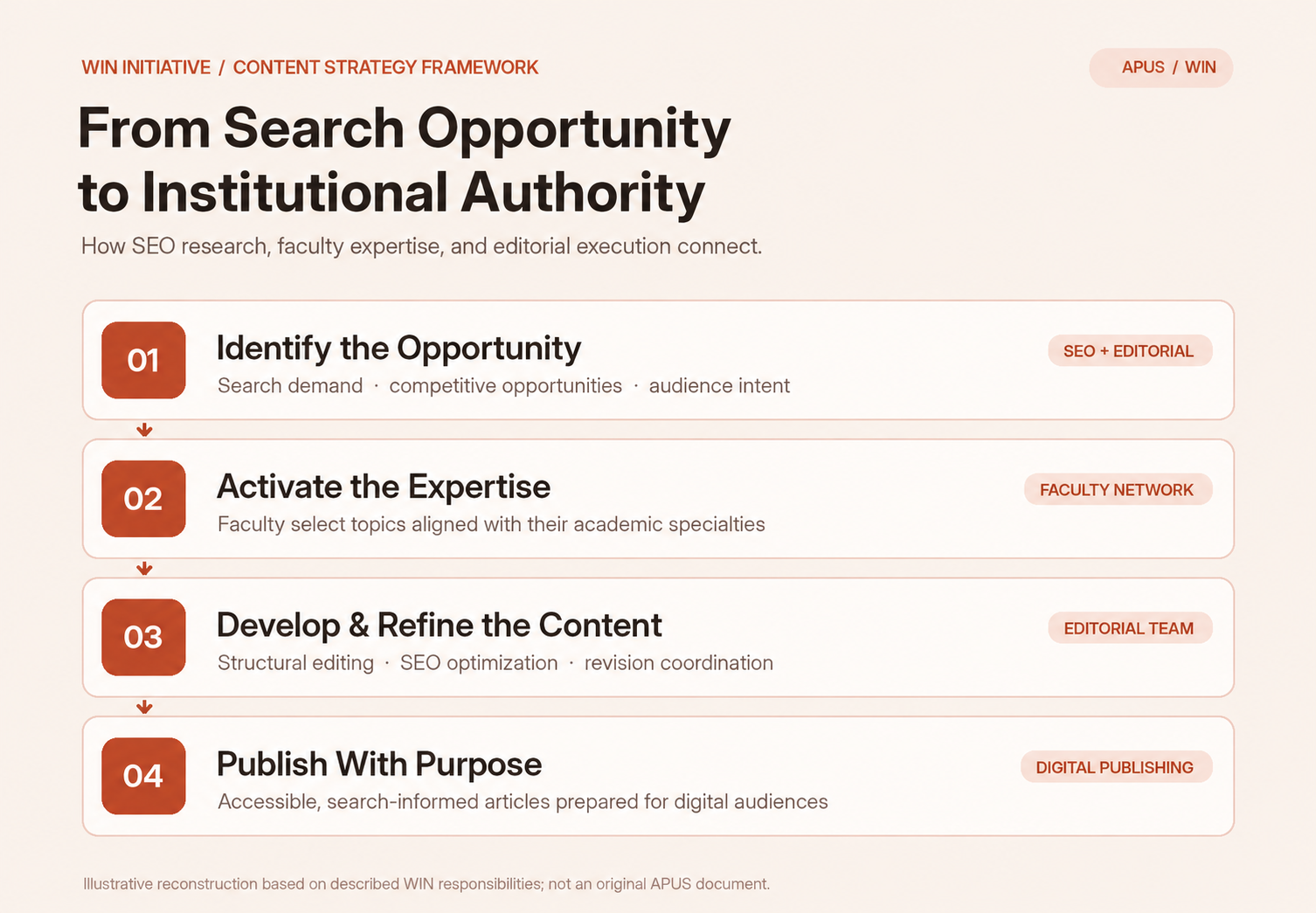
My role connected SEO-driven topic planning with editorial development. Working alongside SEO specialists, I helped identify competitive search opportunities and develop curated topic lists for faculty contributors. Once articles were submitted, I oversaw key stages of editorial refinement, optimization, revision management, and publication preparation.
The idea was simple: Let the data reveal the opportunity. Let the experts provide the insight. Build the editorial process that connects them.
The Challenge
An abundance of expertise. An opportunity to make it work harder.
Producing credible, competitive content across a broad range of academic disciplines presents a particular challenge in higher education.
Marketing teams understand their audiences, but cannot independently possess the specialized knowledge of every professor, researcher, or industry expert within an institution.
Faculty members possess that knowledge, but academic expertise doesn't automatically translate into effective digital content. Search intent, accessibility, editorial structure, and publishing requirements introduce an entirely different set of considerations.
APUS needed a way to bring those capabilities together—expanding content development without compromising subject-matter integrity, audience relevance, or editorial quality.
The challenge wasn't creating expertise. It was building a better system for putting that expertise to work.
The Strategy
Three disciplines. One coordinated content model.
WIN connected search intelligence, faculty expertise, and editorial execution through a more deliberate approach to content development.
01. Find the Opportunity Before Creating the Content
Search demand should inform the investment. Expertise should justify it.
Drawing on my Semrush SEO certification and practical experience in organic content strategy, I collaborated with SEO specialists to identify topics where APUS had a realistic opportunity to compete in search.
Together, we evaluated keyword opportunities, competitive positioning, audience intent, and topical relevance to develop curated lists of potential articles.
Faculty contributors then selected subjects aligned with their academic knowledge and professional experience.
This allowed us to connect audience demand with qualified subject-matter expertise before committing resources to content development.
Rather than publishing indiscriminately, we were pursuing opportunities where the institution had both something valuable to contribute and a strategic reason to contribute it.
02. Turn Specialized Knowledge Into Compelling Content
Protect the expertise. Strengthen the experience.
Once faculty members submitted their work, my focus shifted from content opportunity to editorial execution.
I edited and optimized dozens of faculty-authored articles, refining their organization, clarity, narrative structure, search relevance, and alignment with institutional brand standards.
This involved reviewing supporting references, strengthening headings and internal linking, evaluating how effectively each article addressed audience questions, and requesting revisions when necessary.
The work demanded editorial judgment and an appreciation for the contributor's expertise. An article could be intellectually rigorous yet difficult for a general reader to navigate. Conversely, excessive simplification could diminish the nuance that made it valuable.
My responsibility was to help bridge that divide.
The goal was never to make professors sound like marketers. It was to make their knowledge accessible without sacrificing what made it worth sharing.
03. Make Expertise a Repeatable Editorial Resource
An article is an asset. A sustainable process is a capability.
WIN's broader opportunity was to make faculty-informed publishing more systematic.
By connecting research-backed topic selection, faculty contributions, editorial refinement, revision management, SEO optimization, and publication preparation, our team supported a more coordinated content pipeline.
I helped guide submissions through those editorial stages, adapting to different subjects and writing styles while maintaining consistent standards.
This approach supported increased publishing cadence and enabled the content operation to draw more effectively on the institution's existing intellectual resources.
Rather than relying exclusively on marketing writers to research complex subjects independently, we could integrate the knowledge of experts directly into the development process.
We weren't simply producing additional articles. We were helping create a more sustainable way to produce specialized content.
Results & Business Impact
Expanded editorial capacity. Greater subject-matter depth. A more strategically aligned content operation.
WIN demonstrated how existing institutional expertise could support a broader, more coordinated approach to digital publishing.
Dozens of Faculty-Authored Articles
Personally edited, optimized, and prepared dozens of expert contributions for publication, helping turn specialized academic knowledge into accessible, audience-focused content.
Search-Informed Content Development
Collaborated on curated topic pipelines informed by competitive SEO opportunities, creating a clearer connection between editorial investments, faculty capabilities, and audience demand.
Broader Content Capabilities
Supported a repeatable publishing process that drew on faculty knowledge across disciplines, strengthened editorial collaboration, and contributed to increased content production cadence.
The larger achievement was establishing a stronger connection between what the institution knew, what audiences wanted to understand, and how our content operation could bring the two together.
WIN in Practice: Where Expertise Meets Execution
Three disciplines. Three expert perspectives. One editorial standard.
Great editorial strategy must be as adaptable as the subjects it serves.
Through WIN, I edited and optimized dozens of faculty-authored publications, bringing structure, clarity, search intelligence, and audience relevance to complex subjects across multiple academic disciplines.
These selected collaborations demonstrate that versatility.
Strategic Intelligence & National Security
What Is Strategic Intelligence and Why Is It Important?
Dr. David James Kritz | American Military University
Making sophisticated intelligence concepts accessible through an exploration of national security, intelligence disciplines, and strategic decision-making.
Artificial Intelligence & Philosophy
AI and Human Consciousness: Examining Cognitive Processes
Dr. Steven Wyre | American Public University
Bringing philosophical inquiry and emerging technology together in an accessible examination of machine intelligence and human cognition.
Education & Digital Safety
Teaching Students About Cyber Safety: Essential Tips for Educators
Dr. Kathleen Tate | American Public University
Translating research-informed educational expertise into practical guidance on digital citizenship, online privacy, and student safety.
My Contributions Across All Three Publications
Editorial Development • SEO Optimization • Structural Refinement • Revision Coordination • Publication Preparation
Beyond the Numbers
Some of the greatest opportunities in business begin with recognizing the value of what already exists.
WIN reinforced an important lesson in my approach to content strategy: meaningful growth doesn't always require more resources. Sometimes, it requires a better way of connecting the people, knowledge, and capabilities already within an organization.
Our SEO specialists understood where opportunities existed. Our faculty brought the expertise. Our editorial operation helped transform that intersection into content audiences could discover, understand, and use.
For me, WIN demonstrated that effective content leadership is about more than directing what gets published. It's about recognizing opportunities, connecting complementary strengths, and helping build systems that make those strengths more valuable together.
Because genuine authority isn't manufactured through content. It's revealed through the knowledge, people, and perspectives behind it.
Notable Professional Copywriting Projects
Program/Landing Pages
American Public University System (APUS)
Education Degrees and Certificates
Published Blog Articles
APUS
Effects of Climate Change on the Environment: A Global Crisis
Shaping Tomorrow’s Space Force: CMSgt. Bentivegna on Security and Progress
Major Theories of Child Development: Frameworks for Learning
Qualities of an Early Childhood Educator to Inspire Learning
Observation Techniques in Early Childhood Education That Matter
Rasmussen University
Graphic Design and Artificial Intelligence: What Designers Think About The AI Wave
Aspen U
Nursing Resumes Do’s and Don’ts: How to Craft a Strong Resume
Notable Video Projects
Balancing Work, Study, and Growth: Naomi’s Path to What’s Next (15-second)
APU Gives You the Power to Live and Learn.
Balancing Headlines and Deadlines: Liberty Simmons' Academic Pursuit at AMU (15-seconds)
From Deployment to Degree: Brandon Villanueva's AMU Journey (15-seconds)
Flexible Education for Transitioning Military | American Military University
Balancing Work, Study, and Growth: Naomi’s Path to What’s Next (30-second)
The Power to Be Unstoppable at APU
Balancing Headlines and Deadlines: Liberty Simmons' Academic Pursuit at AMU (30-seconds)
From Deployment to Degree: Brandon Villanueva's AMU Journey (30-seconds)
Got My Six
Mentors & Life’s Mazes
Gen AI and Writing
Post with Power: Social Media for Professional Growth
ePortfolios: Where Personality Meets Professionalism
The Strategy Behind the Scroll
Social Media Strategy & Campaign Copy
Different audiences. Different objectives. One consistent standard: Make every word matter.
Social media is a crowded conversation. Capturing attention is difficult. Earning it requires something more than a clever headline or a well-placed call to action.
It requires understanding the audience, recognizing what makes a subject relevant, and finding the right way to communicate its value.
At American Public University System, I've developed social media copy across a broad spectrum of academic disciplines – from intelligence and cybersecurity to healthcare, business, education, and emerging technology.
The challenge is rarely just deciding what to say.
It's discovering what makes someone want to listen.
The Strategy: Audience Before Algorithm
My approach to social content centers on four principles:
01. Capture Attention
Find the question, tension, or unexpected perspective that makes an audience stop scrolling.
02. Make Complexity Accessible
Translate specialized information into engaging, understandable language without sacrificing accuracy or substance.
03. Adapt the Message
Recognize that different audiences, subjects, and stages of consideration demand different creative approaches.
04. Inspire Action
Give audiences a meaningful reason to continue exploring, whether through an article, academic program, or broader conversation.
Selected Social Media Work
Six examples. Six distinct communication objectives.
Awareness & Discovery | Geospatial Intelligence
“What if you could predict a crisis before it happens—just by reading a map?”
An unexpected question introduces geospatial intelligence through something immediately understandable: the power of information to anticipate real-world events.
Editorial Objective: Spark curiosity, simplify technical subject matter, and encourage further exploration.
Emotional Connection | Nursing Careers
“Pros and cons of being a nurse? Let's be real.”
Rather than relying on conventional career marketing language, this approach acknowledges the emotional demands and meaningful rewards of nursing.
Editorial Objective: Establish authenticity and connect with prospective students considering a demanding, service-oriented profession.
Consideration & Decision Support | Legal Studies vs. Paralegal Studies
“Both are valuable, but your career goals should drive your choice.”
A comparison-driven approach helps prospective students distinguish two related academic pathways and evaluate which better aligns with their ambitions.
Editorial Objective: Provide practical guidance to an audience actively weighing educational options.
Thought Leadership | Ethical Entrepreneurship
“Big ideas can change the world—but without ethics, they can also break it.”
A provocative contrast introduces the intersection of innovation, accountability, and responsible business leadership.
Editorial Objective: Encourage critical thinking and create a more substantive conversation around entrepreneurship.
Emerging Issues | Cybercrime
“The next big heist won't happen in a bank—it'll happen on a server.”
A familiar cultural reference reframes the evolving nature of crime, making an increasingly technical issue feel urgent and relevant.
Editorial Objective: Connect an emerging threat to everyday awareness and encourage deeper engagement.
Creative Storytelling | Criminalistics
“They don't chase suspects. They chase the truth.”
A concise, cinematic hook challenges assumptions about criminal investigation while emphasizing the scientific work performed behind the scenes.
Editorial Objective: Differentiate a specialized career through distinctive storytelling and memorable language.
Beyond the Scroll
Strong social content doesn't begin with a platform. It begins with a person.
Every audience brings different expectations, questions, motivations, and levels of familiarity to the conversation.
The responsibility of effective content development is to recognize those differences and create messages that connect.
These examples demonstrate how curiosity, emotion, practical guidance, and creative storytelling can serve distinct communication objectives while maintaining a consistent editorial standard.
Because successful communication isn't simply about being seen. It's about giving people something worth paying attention to.
Selected copy developed for American Public University System. Editorial objectives describe the intended communication approach, not independently measured campaign results.
Strategy and Workflow
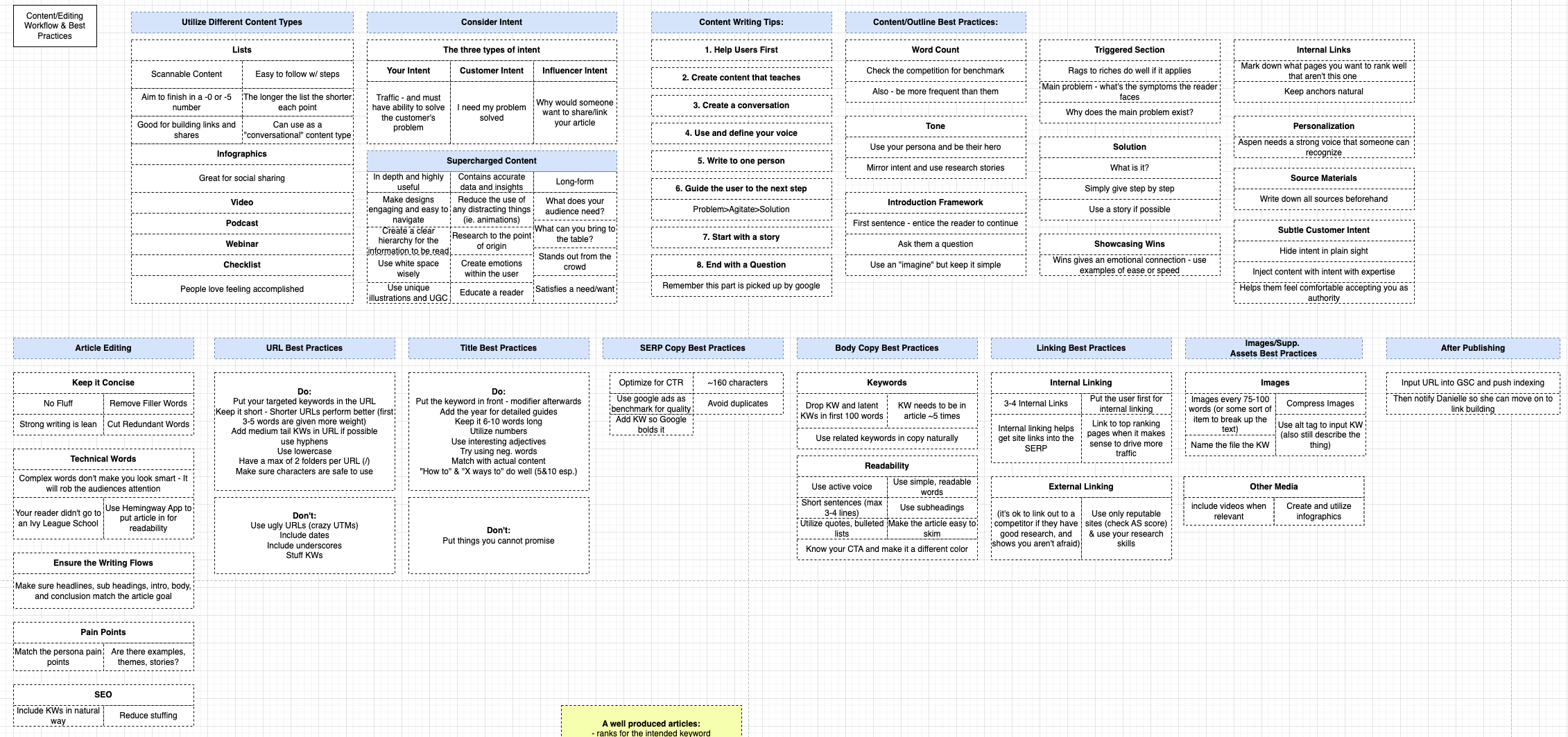
Content & Editing Best Practices

Blog Framework

Keyword Research Framework

Measuring Results Workflow
Creative Works
Below is a collection of sample work I have created. Short stories, essays, screenplays, and short films. A diverse portfolio, I am able to effectively navigate different genres, layering engaging conflicts, developing complex characters, and providing a unique voice, tone, and resolution, while following the 3-act narrative structure, including Blake Snyder’s beats.
Short Stories

The Lake of Lions is an extended metaphor for those broken souls who neglect their potential. Those who run from their identity, afraid, anxious, and abiding, blind to the latent power suppressed inside, trapped within.
I wrote this visceral story during a time of heavy circumstances. My objective was to create a quick hit of inspiration consisting of intimate truths, poetic elements, and brutal imagery.

The Slave and the White Whale is the short story of an escaped slave's voyage to freedom across the sea, and his encounter with the white whale which challenges the protagonist's ethical code and will to survive. Freedom is not everything, if everything is not free.
My mission was to write a conventional story without an overpowering narrative voice.
Inspired by Melville's Moby Dick and the Narrative of the Life of Frederick Douglass as an American Slave.
Screenplays

Brimstone tells about a young son struggling to gain his identity as an adult capable of handling himself. Set in a post apocalyptic world where childhood is an endangered luxury, Brimstone is a dark, oppressing, tale of redemption and revelation.

The quote goes: The Devil you know is better than the Devil you don't. The Devil You Know is a fun short story about someone pigeonholed and misunderstood who tries to break free of those labels associated with his reputation so that he can define himself as he wishes in a journey to seek fulfillment.
Inspired by the old myth about the man who sold his soul to the devil at the crossroads when the night was the darkest.

A surreal tale about a man who's tasked with chauffeuring the dying to their final resting place, The Ferryman is a story about a man's fight against time and mortality and an elderly lady's final quest to reunite with the love of her life.
The Ferryman was inspired by Charon, who is a greek mythological entity responsible for chauffeuring the dead across the River Styx and the River Acheron, which separated the living world from the dead... and David Lynch.

A man of wealth, power, and privilege ventures alone into an unforgiving desert, abandoning a life meticulously constructed around success, appearances, and control.
But beneath his immaculate exterior lies a lifetime of buried guilt, painful memories, and truths he has desperately tried to escape.
As the relentless sun strips away his possessions, dignity, and identity, the boundaries between reality and delirium, civilization and savagery begin to dissolve. What follows is a harrowing descent into the darkest recesses of the human psyche, where the past refuses to remain buried and survival becomes inseparable from self-destruction.
Blending psychological horror with existential allegory, The Creature explores the corrosive nature of guilt, the fragility of identity, and the monstrous consequences of running from oneself.
When everything that defines us is stripped away, what remains beneath the surface—and is it still human?
Creative Writing

A dynamic summation and preview of what to expect for season 2 of Netflix’s radical series: Love, Death, Robots.

A Satire for Self-Destruction is a piece intended to poke fun at and combat all the self-anointed heath professionals of the here and now, their goofy blogospheres, and their righteous regiments.
Short Films

Tomato Juice is a film that examines the relationship between a newly divorced mother and her preteen son who has just been cut from the soccer team. The film details the recognition of being excluded from meaningful relationships and how to transcend a shared conflict through an unexpected outlet.
Tomato Juice was my second-year thesis film in grad school. I aimed to tell a simple but meaningful story that was more mature and less moody.
Inspired by my younger sister's one wish for her 5th-grade graduation: A big juicy tomato to throw at our backyard fence. The film was also inspired by Jane Campion's short film, PEEL, and real-life events.

The Ballad of W.E. Blackburn is an experimental short film chronicling a death-row prisoner's final moments alive.
This film was made at the end of my first year of graduate school. The film was adapted from a short story I wrote called A Necessary End, which you can read above.
Inspired by T.S. Eliot's poems, The Love Song of J. Aflred Prufrock and The Hollow Men.
MEAT

MEAT is a peculiar reminder of man's primal instincts. MEAT was shot on 16mm film. The film was inspired by my need to tell a story without many resources, a skill Rob's gotten used.
I have always been fascinated with the animal instincts that survive in us today, believing it's important to remember and recognize our history and the natural foundations uniting all of us and nature, because it sheds light on what it means to be alive and human.